Wednesday, December 7, 2016

A Picture Book of Florence Nightingale by David A. Alder


  • Age Range: 6 - 9 years
  • Grade Level: 1 - 3
  • Lexile Measure: 760L
  • Series: Picture Book Biography
  • Paperback: 32 pages
  • Publisher: Holiday House; Reprint edition (March 1, 1997)
  • Language: English

From inside flap: Florence Nightingale was born on May 12, 1820, to wealthy English parents. Although it was not customary at the time for someone of her background to become a nurse, she felt it was her calling. Her parents were horrified, as nineteenth-century hospitals were dirty and primitive. Still, Florence tirelessly pursued her dream, serving the poor and sick. She became the superintendent of a hospital in London, cared for the wounded in the Crimean War, and campaigned for improved medical conditions for British and American soldiers. Florence Nightingale's high standards for health care revolutionized the nursing profession.


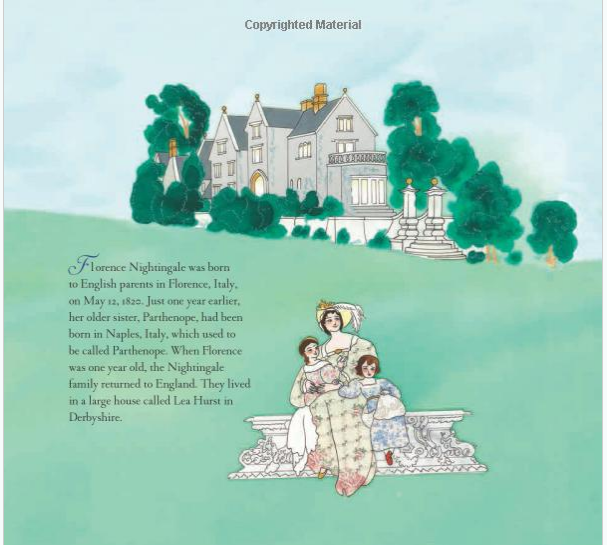
My Review: I know that Adler's books circulate frequently, but this book is...lacking. Lacking flow, lacking information. Overall, this book provides a very basic overview of Nightingale's life, it includes very little dates, or substance. Basically the book says: she was a dreamer, refused marriage, finally got her wish to study nursing, attended the wounded in the Crimean War, and died secluded with her many cats. Adler spends more time on her parent's child naming reasons than he does on the major aspects of her life and career. The illustrations aren't particularly attention grabbing, have the quality of hazy water colors. I'd not recommend this book for a collection. 


Better Reads on Florence Nightingale


Florence Nightingale / Demi.
Florence Nightingale revolutionized the world of medicine by emphasizing cleanliness, food that was hot and nutritious, and organization in hospitals. What began as an attempt to make army hospitals safer and more effective became a lifelong mission, and remains relevant today. This new picture book biography of Florence Nightingale, from celebrated author and artist Demi, beautifully portrays the story of Florence's life and explores the long-lasting effects of her career.


Florence Nightingale : the lady of the lamp / Barnham, Kay.
Florence Nightingale was born in 1820 to a wealthy family. Against the wishes of her parents, Florence soon realized her dream to nurse and became superintendent at a hospital in Harley Street, London. However, it was for her work during the Crimean War that Florence is most remembered. Upon arrival at the British army hospital in Scutari, Turkey, Florence and her nurses set about bringing order to the filthy, diseased chaos that greeted them. Sickened by what she had witnessed at Scutari, at the end of the war Florence returned to London where she dedicated the remainder of her life campaigning for better nursing facilities both in the army and civilian life. (Amazon).

Tuesday, December 6, 2016

The Queen's Progress by Celeste Davidson Mannis


  • Age Range: 5 - 8 years
    Grade Level: Kindergarten - 3
    Hardcover: 48 pages
    Publisher: Viking Books for Young Readers; First Edition edition (May 26, 2003)

    Book Summary from Amazon:
    Rhymed verses, stunning illustrations, and a fascinating text all come together to form this imaginative story about Queen Elizabeth and her progresses, or journeys, through England's countryside. Ibatoulline's illustrations are not only beautiful colorful works of art, they also tell a story within a story-one about the attempted murder of the queen and about her loyal servants who seek revenge. The main text follows Elizabeth's travels and is filled with anecdotes and historical details.

    Perfect for history-lovers, alert readers, and suspense-seekers, this multi-layered picture book reveals something new with each reading.

    My Review:
    With Elizabeth I being my favorite English queen, it's not much of a surprise that I liked this book. The Alphabet part of the story is told in rhymes,


and each letter has a corresponding prose fact. This, in my opinion, makes the book multi-use, you could read the letter rhymes, the prose facts, or read them all, depending on the age and attention span of the reader or listener.


I love Ibatoulline's illustrations. They're detailed, and very Tudoresque. Ibatoulline inlcudes subtle details about the story, like the many attempts on Elizabeth's life: pictured below Elizabeth's page stops an arrow from hitting the Queen.


My nephew loves the rhymes, and my niece (who is older) likes the prose facts, so this is a good book to read-a-loud to them. 

Overall, the language and the illustrations make it appropriate for children; It's format is like that of an "easy" reader fiction book, so even though it's non-fiction, it will still engage and amuse children.

Read-a-likes:

Paul Revere's Ride by Henry Wadsworth Longfellow, Ted Rand (Illustrator)
Just about everyone's studied Longfellow's poem Paul Revere's Ride in school--it was required memorization for me. Rand's illustrations help flesh out Longfellow's words, and make this an entertaining book for kids.


Pioneer Life from A to Z (Alphabasics) by Bobbie Kalman 
A to Z books are handy for kids learn facts about subjects/people like Elizabeth or pioneer life. Pioneer Life is a little more advanced than The Queen's Progress but is equally engaging and informative for young readers.


Tuesday, September 6, 2016

Locomotive by Brian Floca


Age Range: 4 - 10 years
Grade Level: Preschool - 5
Lexile Measure: 840L
Hardcover: 64 pages
Publisher: Atheneum/Richard Jackson Books
Published: September 3, 2013
Honors: Caldecott Medal Winner, Sibert Honor Book


Book summary from Amazon:
It is the summer of 1869, and trains, crews, and family are traveling together, riding America’s brand-new transcontinental railroad. These pages come alive with the details of the trip and the sounds, speed, and strength of the mighty locomotives; the work that keeps them moving; and the thrill of travel from plains to mountain to ocean.

My Review:
Brian Floca’s Locomotive is an excellent nonfiction choice for kids. There are a lot of illustrations in this book, and the detail is amazing. This book is written in narrative- verse form.


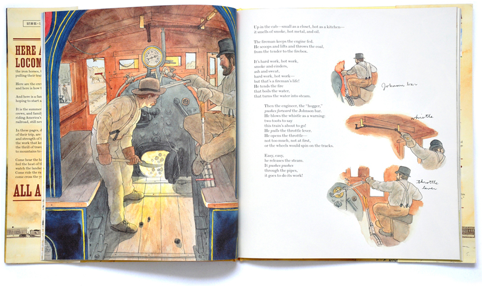
The details about locomotives are fun, and informative—without being too overwhelming. The amount of illustrations and the detail of them makes this book an excellent nonfiction book for kids, it doesn’t feel like a “traditional” non-fiction book. The image below is an example of how detailed with the little thing Floca is:


There are a ton of words in this this book which does kind of make it a chore to read aloud, but because of the illustrations and the fun verse format the kids love to hear it, and like to just look through it on their own at times.


  My older readers like the history and map in the front of the book, and the detailed illustration and information on the steam engine on the inside of the back cover.


There is one issue I could potentially see for the illustrations in this book—cursive writing:
In several places Floca uses cursive writing in several illustrations, this is potentially problematic for future children because cursive isn’t really taught in schools these days, and cursive is really becoming a dying art.


Overall my youngest nephew and I really enjoyed this book—so much that he got it for his birthday.

Sunday, August 3, 2014

Lego Movie


What were the writers on? Seriously. This is the stupidest movie I have seen in a long time. I want that hour and forty minutes of my life back. Bad dialog, a mash up of other better movies, and very little plot. Seriously the thing that made Emmet special was that his mind was so incredibly blank, and lets face it--he was a complete moron. This movie an hour and forty minutes of stupidity and innuendos. The fact that some of the people in my family love this movie makes me wonder about them. If you have to mention that "everything is awesome" it most certainly is not!

My View on Videogames

I have very little experience with videogames and MUVEs, unless Farmtown counts. I prefer books and people to screens and controllers. While I concede that there are some benefits to computer and videogames, I believe that they are unnecessary. Videogames lack in so many ways, they are completely limited by the programing. I believe that they don't encourage creativity, critical thinking skills, or social skills.

Virtual environments can connect users across the globe, but also have limitations. With the rise of texting, Facebook, Twitter and online communities the art of communication is being lost. Without voice tone, body language and social cues, electronic communication lacks connection and emotion. While some people and libraries believe that virtual environments are handy, and have presence in MUVEs, I do not believe that virtual environments are necessary for libraries. For communicating with librarians I believe that e-mail, and chat rooms go far enough, but if it isn't enough contact visitors can always visit their local library.

Saturday, August 2, 2014

The place of "Social" Media in our Libraries.

I joined Facebook in 2007. It was all the rage, everyone did everything on Facebook. Fast forward 10 years and I use my Facebook profile to log in to everything. I really liked Facebook, it was cool it was a way to keep in touch with friends that had spread all across the country; however these days it's all game postings, people I have very little in common with anymore, and my biggest pet peeve: factually incorrect chain letters/pictures. These days I use Facebook for one reason: to keep up with my two siblings that live far away and their children.

Twitter is still like. I love that I can follow authors, actors, athletes, t.v. shows, the British Royal Family. I can also follow my library, the zoo and local businesses. The biggest draw of twitter to me is that I choose who to follow, no one else can make that decision for me.

Facebook and Twitter both have a place in today's library. They represent cheap marketing strategies. It's easier to keep your patrons informed of library happenings, it makes it easier to attract interest. Twitter could easily be used to ask librarians reference questions. Facebook can be used to post in more detail about the library and library programing.

Thursday, January 21, 2010

Censorship and Ethnocentric Views

Apparently France is considering a ban on all burqas, and there are some in this nation who believe we should do the same. Here is the link to an article on Politics Daily, by a liberal, who believes that we should do the same : France's Proposed Burqa Ban: Why Americans Might Want to Consider It Too -- Politics Daily.

My comment was not approved to be added in the comments section, so I will post it here:

The burqa for many is a sign of subservience, of oppressiveness, of second class citizenry, but the burqa, head coverings, and scarves are all aspects of these women's cultural heritage. The idea to ban the burqa is entirely ethnocentric! You are judging another culture by your own morals and standards and are condemning it as barbaric. This is WRONG! Ethnocentric views have led to countless atrocities through out history! The author states that it feels to her as if they are holding American women back, and that when she sees women wearing these items she takes it as an affront. She is judging them for exercising their rights! The idea that a veil or burqa could hold American women back is completely ridiculous! In America these women CHOOSE to practice their CULTURE by wearing their burqas or veils. It is their right to do so! Does every woman willingly wear a burqa- probably not, but for those who do--it is their right. The idea that we should ban or censor what people can wear is terrifying! Censorship is a slippery slope, that leads to infringements on our most basic rights. Just because it makes people uncomfortable is not a reason to ban the burqa. I wear a cross, a symbol of my religion and culture, I have views and opinions that make people uncomfortable, I will not be censored, and I will not tolerate, or support the censorship of others or their culture.

Now more on the subject:
Ethnocentric views are very very dangerous! Hitler was ethnocentric! The jihad is an ethnocentric war!

As for censorship- It is a dangerous tool, because it limits our ability to think for ourselves.